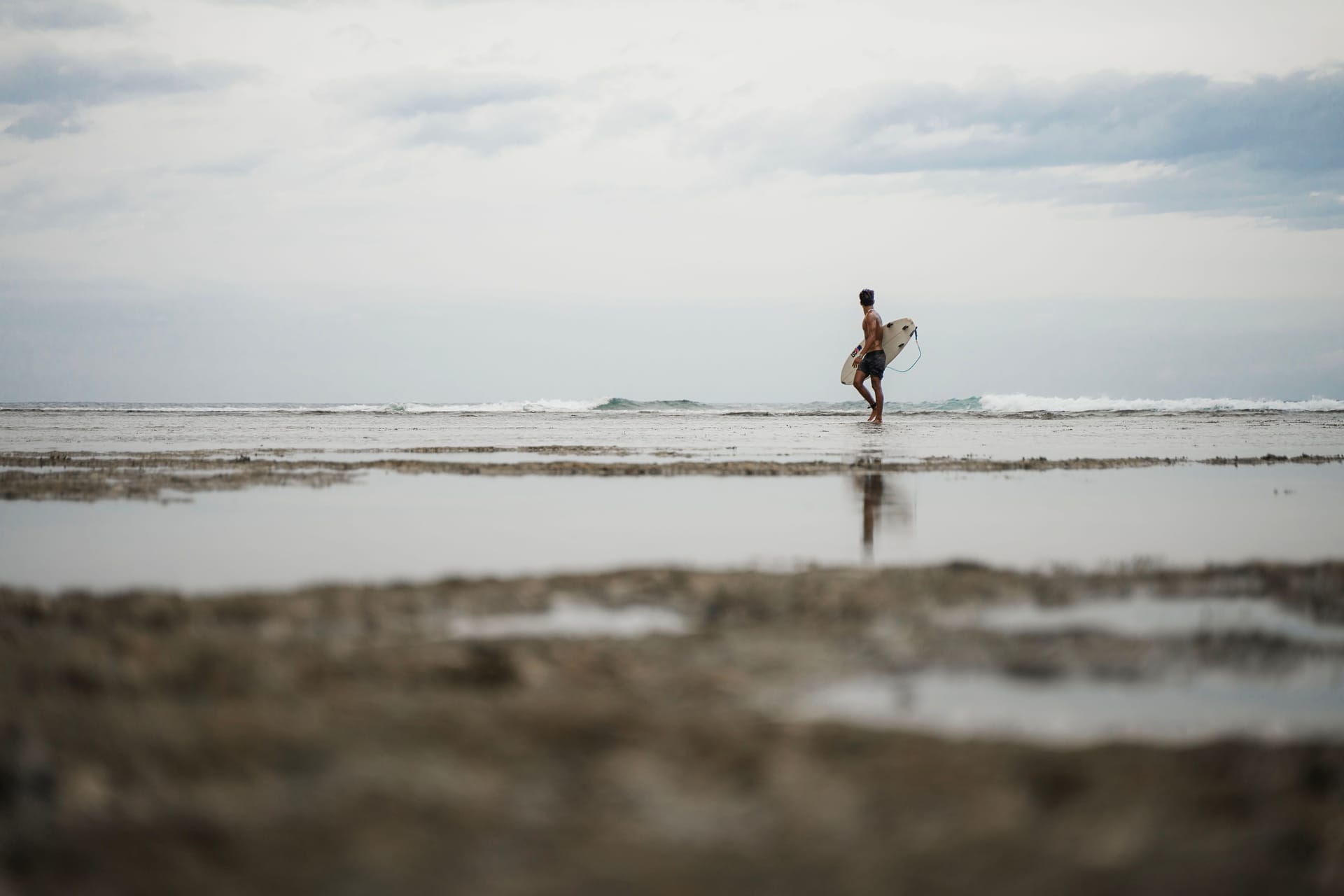
You land in Bali or Jakarta, connect to Kupang, then cross the last stretch of water to Rote by a small turboprop or the fast ferry. That final crossing decides whether your gear arrives whole. This is written by someone who does the run twice a year, once with a board under the arm and once with the boring cargo that keeps a house alive on an island of 1,227 square kilometres where almost nothing you need is for sale 1. So when I talk about flying to Rote with surfboards, I mean the same trip that carries a satellite router, a box of tools and six months of medication in the next bag along.
Nothing here is a hack. The limits are real, they are physical, and the aircraft has the final word. The single number to hold in your head before you book anything: the Wings Air hold on the Kupang leg stops taking a bag much over about 250 cm, and it will not argue the point with your policy printout. Everything else on this page is about the three handoffs between the plane door and your front gate, because that is where things actually break.
The run, leg by leg, and which one actually costs you
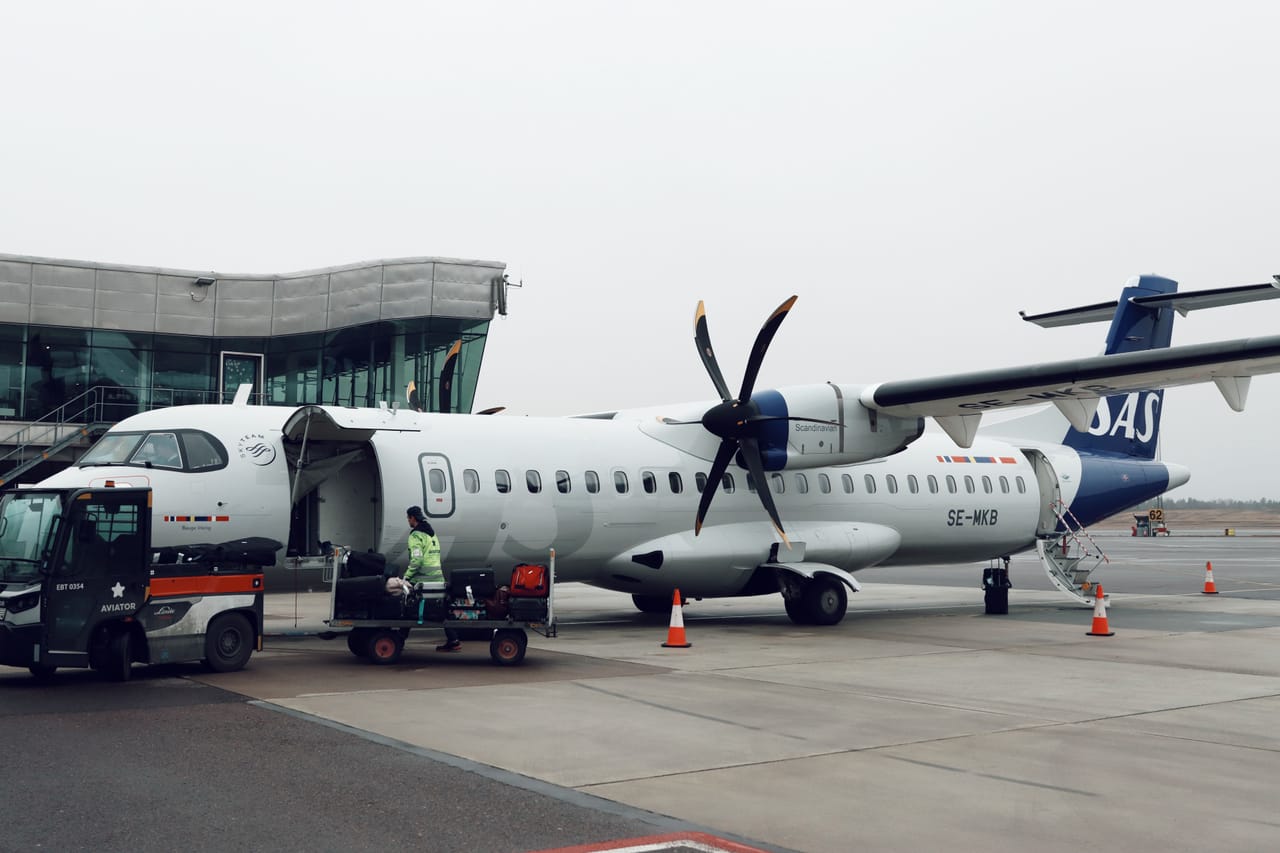
Before any airline detail, look at the whole chain at once. Every ranking page tables the airlines. Almost nobody tables the journey, which is the part that surprises people. The Kupang to Rote leg is short in kilometres and long in consequences, and it is the one where a full plane, not a rulebook, leaves your board on the tarmac.
| Leg | What carries your load | Rough cost (as of 2026) | What breaks here | If it fails |
|---|---|---|---|---|
| International into Bali/Jakarta | Widebody, deep hold | Included or excess per kg | Nose and fins crushed under stacked bags | Claim with the international carrier |
| Domestic hop to Kupang | 737 or A320 | Excess + oversize, | Board bag dropped onto the belt tail-first | Overnight, rebook the onward leg |
| Kupang to Rote (Wings Air) | ATR 72 hold | Oversize board charge, | Length limit, bag bumped from a full load | Board waits for the next day’s flight |
| Kupang to Rote (Express Bahari) | Fast-ferry deck and cargo bay | Ticket | Deck knocks, salt spray, boot heels | Next sailing, or a weather day lost |
| Ba’a to the house | Pickup bed or bemo | Fuel plus driver, | Unsealed-road bounce, strap rash on the rails | Re-strap and drive slow |
Figures are converted at roughly 16,000 rupiah to the US dollar as of early 2026, and they move, so treat them as a shape rather than a quote. The pattern that matters holds steady: the cheap short legs are the dangerous ones.
Airline limits on the Rote route in 2026
The domestic carriers you will actually use are Lion Air, Batik Air, Citilink, Super Air Jet and, for the final water-jump, Wings Air. Garuda flies the trunk routes and treats a board bag with the most care, at the highest price. TransNusa and the low-cost brands run tighter holds and count every kilo.
Two rules save you money on the domestic legs. Pre-pay excess baggage online rather than at the counter, where the walk-up rate can run half again as high. And weigh the whole load at home, because the oversize surcharge on a board bag stacks on top of the per-kilo excess, so a heavy bag that is also long gets billed twice.
The travel writer William McGee, who spent nearly seven years inside airline flight operations, makes the point that baggage fees and shrinking allowances are symptoms of a deeper squeeze on the whole system rather than isolated charges 2. On the Rote route you feel that squeeze most on the Wings Air segment, where the aircraft itself is the constraint.
The Kupang to Rote hop flies an ATR 72 turboprop. Its hold is a fixed shape, and the length limit is the airframe, not a policy someone can waive at the desk. A short board slips in. A longboard or a coffin bag with three sticks and a windsurf mast does not, on any day, at any price. Worse, even a legal-length bag can get bumped when the flight is full and the hold is already loaded with rice, engine parts and someone’s new fridge. When that happens your board flies the next morning while you land board-less. Build for it: carry your fins, leash and wax in the cabin bag so a delayed board is an inconvenience, not a wasted first swell.
Book the Wings Air Kupang to Rote leg early in the day. The first flight has the emptiest hold, and if the weather turns and the turboprop cancels, you still have the afternoon ferry as a fallback out of the same city.
The international leg
Your board takes its worst structural hit before you ever reach Indonesia’s domestic system, in the deep hold of the widebody flying you in. Bags get stacked, and a board bag laid flat under two suitcases takes the load across its weakest span. Pad the nose and tail hard, tape the fins flat or pull them, and mark the bag FRAGILE in Indonesian, “BARANG PECAH BELAH”, so the Kupang ground crew reads it too. Most international carriers fold a board into the standard allowance or charge a flat sports-equipment fee; confirm the exact number when you book, because it is the one fee that changes least once paid.
Getting a long bag onto the Express Bahari
The fast ferry is the honest alternative to the turboprop, and for a longboard it is often the only one. The Express Bahari catamaran leaves Kupang’s Tenau or Bolok terminal in the morning and runs to Ba’a in around two hours in calm water, longer when the swell is up between roughly June and September, when a rough crossing can cancel the sailing outright.
Picture the loading. It is 08:00 at the terminal, the ramp is a scrum of families, sacks of cargo and motorbikes being walked aboard, and a porter wants to take your 9-foot bag from you the moment you step out of the car. Let him, but follow it. Boards ride on the open rear deck or lashed against the cargo bay, and that is where salt spray, other people’s boot heels and shifting freight do their work. Tip the porter, point to where you want it laid flat rather than stood upright, and if you can, sit near it. A motorbike counts as cargo and loads through the same ramp, so if you are shipping a bike over for the season, the ferry, not the plane, is how it gets there.
Buy the ferry ticket the day before in peak months. The fast boat sells out, the schedule thins in rough-sea season, and a missed sailing means a night back in Kupang before the next one.
What gets broken, and exactly where
Here is the honest part no surf blog writes, because it stops when the plane lands. Damage on this route is not random. It clusters at the three handoffs.
A modern surfboard is light and, under the fibreglass, brittle. Most boards are still built on polyurethane foam with polyester resin, a method in use since the 1950s that stays popular precisely because the foam is soft enough to shape by hand, which is the same reason it dents and snaps under a point load 3. Fibreglass is the common skin over that foam, and once the skin cracks, the exposed PU core soaks up water, so a small ding taken in Kupang becomes a waterlogged board a week into your stay 3. The historical monsters carved from solid wood ran over 460 cm and were nearly indestructible; nobody flies those, and everything you do fly is designed to be featherweight, which is the same as saying fragile 3.
Handoff one, the aircraft hold, cracks noses and fins under stacked weight. Handoff two, the ferry deck, delivers rail dings from knocks and salt intrusion through any crack already opened upstream. Handoff three, the road from Ba’a, is the one people forget. The pickup bed bounces on the unsealed sections, and a bag strapped tight against a steel rail gets sanded through at the contact point over 30 minutes of washboard. Lay the bag flat, pad every contact point, and never let a strap cinch directly onto a rail. Pull the leash and fins for transit too, since a fin left on is a lever waiting for a knock, the same physics that once cost surf-leash pioneer Jack O’Neill an eye when an overstretched cord snapped a board back at him 3.
The load that is not a board at all
For most people reading this, the board is one item in a much bigger move. You are carrying a router and a dish for connectivity that the island cannot sell you, power tools, a spare laptop, a printer, prescription medication by the box, kitchen gear and a year of small things that simply do not exist in Ba’a. That load hits the exact same limits and breaks in the exact same places as the board.
Two things go wrong specifically with the non-surf half. Lithium batteries, in power tools and spare laptops, must fly in the cabin, not the hold, on every one of these carriers, and a checked drill battery gets your bag pulled at Kupang. And medication in quantity draws questions at security, so carry it in original packaging with the prescription, split across two bags. Weigh everything, because a satellite kit and a printer will blow your excess allowance faster than any board bag, and the per-kilo charge on the domestic legs does not care how boring the contents are.
Insurance and claims when the damage happened between two operators
The claims reality on this route is grim, and pretending otherwise helps nobody. Domestic Indonesian carriers pay out on hold damage slowly and partially, and the fast ferry offers effectively nothing for a board dinged on its deck. The real trap is the handoff. When your board flew fine on Wings Air but arrived cracked, and it also rode a ferry and a pickup, no single operator will accept that the damage happened on their watch.
Photograph the packed bag before every leg, timestamp it, and photograph any damage the moment you open the bag, at the airport or quay, before you leave. Report it there and get a written property irregularity report before you sign anything. A dedicated boardsport travel-insurance policy that covers “baggage in transit” across multiple carriers is the only cover that reliably pays when the break falls in the gap between two operators. Standard travel insurance usually excludes sports equipment or caps it below the value of a good board.
The return leg and what you leave behind
Repeat long-stayers stop flying gear both ways after the first year. It is expensive, it is slow, and every crossing is another roll of the dice on damage. The sums are simple once you have paid them a few times. Flying a board and a bag of gear round-trip twice a year costs more over three years than shipping a container leg once and storing the rest on the island, and far more than buying replaceable items locally where you can.
So the decision becomes what stays. Boards, bikes and tools can live on Rote between stays, but salt air is patient and cruel: an ungreased chain rusts in a month, a board left in a damp room delaminates, batteries left flat never come back. Kept gear needs a dry, ventilated store and someone to run the engine, air the boards and charge the batteries while you are away. That is exactly the kind of thing the island’s property-care service handles, and it is usually cheaper than a second round of excess-baggage fees plus a fresh set of transit dings. Weigh it against your real cost of living on Rote rather than treating storage as a sunk cost.
Common questions
Can I take a longboard on the Kupang to Rote flight?
Usually no. The Wings Air ATR 72 hold caps a bag at around 250 cm, which rules out most longboards and any coffin bag with a mast. Take the Express Bahari fast ferry instead, where deck loading has no length limit that matters.
How much does it cost to fly a surfboard to Rote?
Budget an oversize surcharge of roughly 150,000 to 250,000 IDR (about $9 to $16 at 16,000 rupiah to the dollar in early 2026) on each domestic leg, on top of any per-kilo excess. Fees change, so confirm the figure when you book each carrier.
Which is safer for boards, the plane or the ferry?
For a short board, the early Wings Air flight if the hold has room. For anything long, the ferry, laid flat on the deck and watched. Either way the road from Ba’a to your house does as much damage as the crossing, so pad the bag for the pickup bed too.
What is the biggest hidden cost?
Missing the Kupang connection. If your inbound domestic flight runs late and you miss the last Wings Air or ferry to Rote, you own a night in Kupang plus a re-booked onward leg. Build a buffer day into the Kupang to Rote sequence and it stops being a risk.
Sources
Footnotes
-
Rote Island — dati (Wikidata). wikidata.org ↩
-
Attention All Passengers: The Airlines’ Dangerous Descent—and How to Reclaim Our Skies. play.google.com ↩
-
Surfboard — Wikipedia. en.wikipedia.org ↩ ↩2 ↩3 ↩4