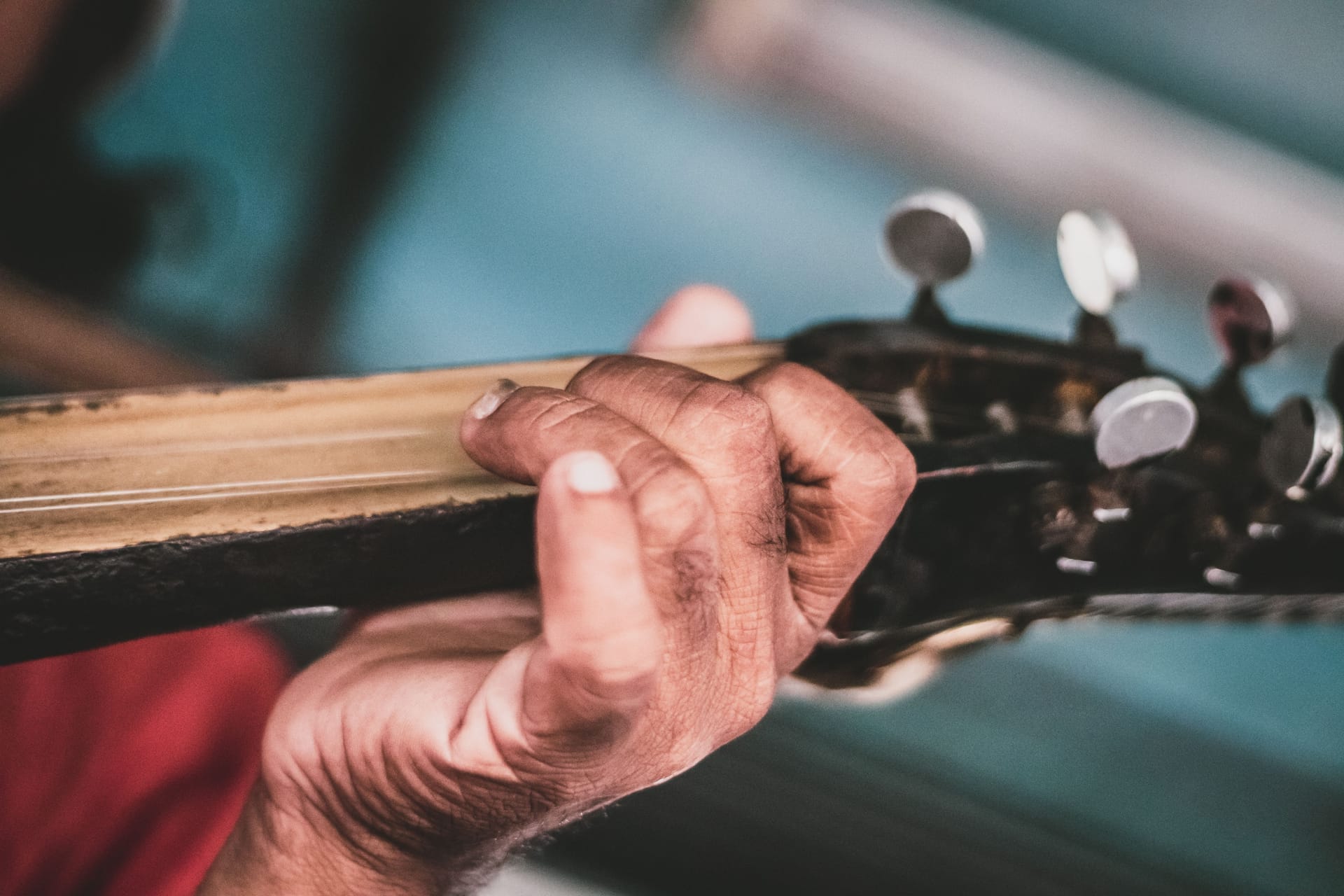
The last time I heard a sasando, it was a Sunday. The sound came through the open side of a church here on Rote, thin and bright, sitting somewhere between a harp and a zither, holding the melody up under the singing. A sasando is a tube zither native to this island, a length of bamboo strung from top to bottom and wrapped inside a wide fan of dried lontar-palm leaves that works as its sound box. The name comes from the Rote word sasandu, meaning vibrating, or sounded.1 You play it with both hands, reaching in from either side. This is the instrument the island claims as its own, and the one you’re most likely to actually run into if you stay here long enough.
What a Sasando Actually Is (and What It’s Made Of)
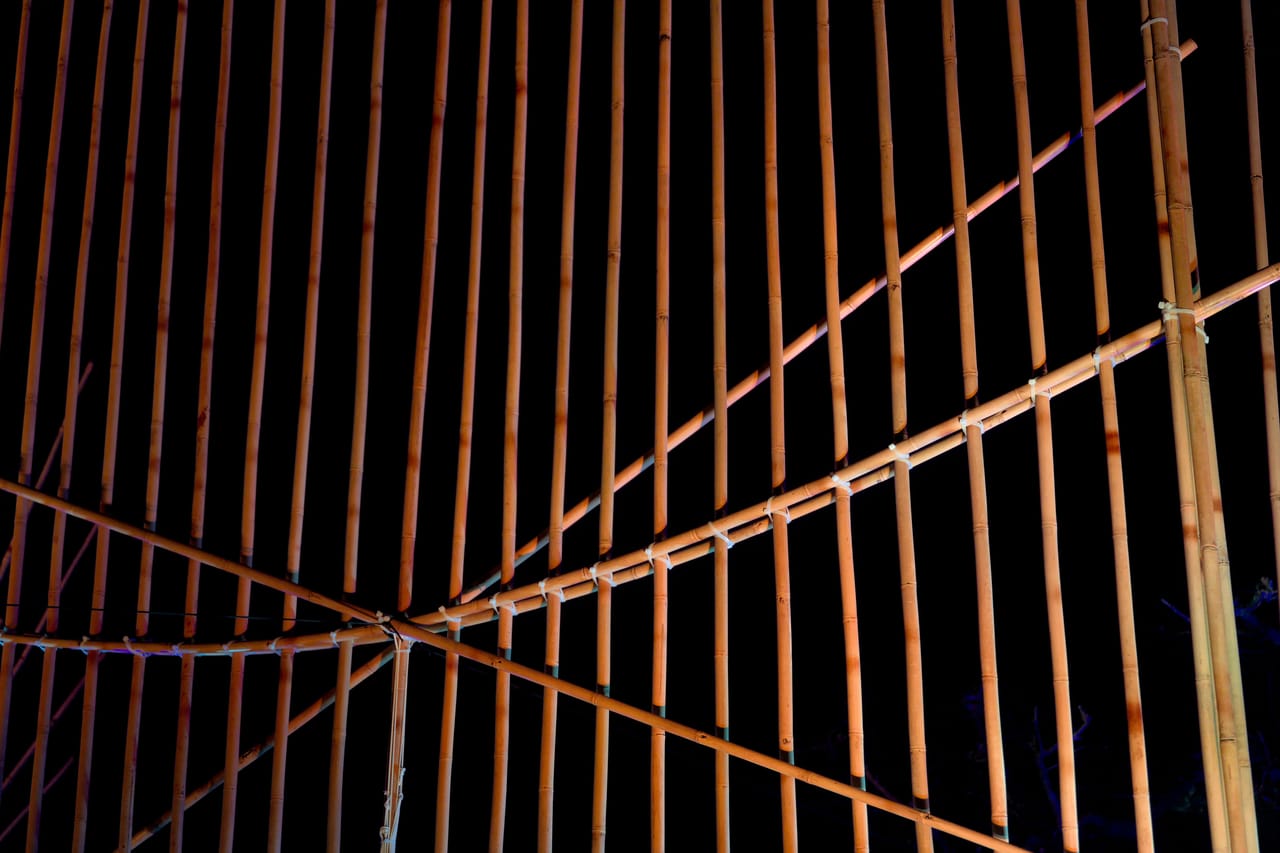
Take the leaf fan away and the sasando is surprisingly plain. The core is a single bamboo tube that acts as the frame. Around it sit small wooden wedges, and the strings run from the top of the tube down to the bottom, passing over those wedges. The wedges do two things. They lift the strings clear of the bamboo surface, and, sitting at different points, they give each string a different working length, which is how the instrument produces different notes.1
Then comes the part that makes it unmistakable. The strung tube sits inside a bag-shaped fan of dried lontar leaves, the palmyra palm, Borassus flabellifer, which acts as the resonator and pushes the sound outward.1 That leaf does real work. It’s the same lontar palm that shades half the island and turns up in the roofs, the mats and the daily food, so the instrument is literally built out of the tree the local economy leans on. Reach your hands in through the openings on either side and you’re playing directly on the strings.
The Gong, Biola and Electric Forms You’ll Come Across

Stay a while and you notice the sasando is not one fixed object. There’s the older acoustic instrument used in traditional ceremonies, the one set up for church music and popular songs, and a modern electric version you’ll see on a stage over in Kupang, plugged into an amp with the leaf fan sometimes stripped off entirely. Players here attach names to them, and you’ll hear the words gong and biola used to tell the ceremonial instrument apart from the one built for songs. The electric one is the version that travels, the one that ends up at official events and on television, while the acoustic instruments stay closer to home.
If you only ever hear one, it’ll probably be an acoustic one at a church or a family occasion. The sound is delicate and does not fill a room the way a guitar does, which is part of why it rewards a quiet setting over a noisy one.
How Old It Is, and the Story People Tell
Nobody can hand you a firm birthday for the sasando. It’s believed to have been known to the Rote people since around the 7th century, and the name traces back to sasandu, sounded or vibrating, from Sandu or Sanu.1 Ask around the villages and you’ll also hear origin legends, told with variations from one place to the next. I’m not going to give you one of them dressed up as history, because the versions don’t agree and I can’t verify them. What is solid is the instrument’s standing here. It’s treated as a cultural inheritance of the Rote people of East Nusa Tenggara, something the island holds onto on purpose.2
That distinction matters if you’re moving here. Treat the sasando as living heritage, still handled and played, an emblem wheeled out precisely because people still want it to mean something.
Where You’ll Actually Hear a Sasando on Rote Today
Now the honest part, the bit the tourism pages skip. The sasando stays scarce in daily life. You won’t hear it drifting out of beach bars or warungs, and no one is busking with one. It lives in specific moments, and if you want to catch it you have to be where those moments happen.
The most reliable one is Sunday. The island’s week is built around church, and Christianity in Indonesia runs deep on Rote, so a service is where a resident foreigner has the best odds of hearing the instrument played in earnest. After that come the big social occasions, where Rotenese wedding customs and funerals both give music real weight, along with official ceremonies and school performances where kids learn it as part of who they are. At the more formal events you’ll often see the wide ti’i langga hat and the sasando brought out together, both standing in for the island itself.
Where you’ll realistically come across one:
- Church, on a Sunday. The steadiest bet, and the easiest to attend as a guest. Sit at the back, dress modestly, follow the room.
- Weddings and funerals. You’ll usually be there as someone’s guest rather than a spectator, so take your cue from the family.
- Official ceremonies and school events. Civic occasions and end-of-term performances often feature it, sometimes the electric version.
The thing to accept is that the calendar delivers it on its own schedule. You wait for the right occasion, and that becomes its own kind of pleasure once you slow down to island time.
Buying a Real One Without Ending Up With a Souvenir
If you want to take one home, know what you’re looking at first. The little versions sold as quick souvenirs, light and small and more ornament than instrument, are a different animal from a full handmade sasando you can actually play. There’s no shelf price on the real ones. You negotiate in person, and a proper playable instrument costs several times what a decorative miniature does. Builders are few, and on an island of only about 1,227 square kilometres the network of makers and players is small enough that word of mouth finds them faster than any search does.3 Kupang, on the Timor mainland, tends to be the practical base for tracking one down before you cross over, since it’s the logistics hub for everything to do with Rote.
Before you pay, look at how it’s built. The construction tells you whether it’s real:
- Strings evenly tensioned, and actually tunable, not just glued on for looks.
- Wedges seated firmly around the tube, since they carry the whole tuning.1
- The leaf fan intact, not cracked or crumbling, because that’s your resonator.
- The sound itself, held up next to your ear. A real one rings; a souvenir thuds.
Handle a few and the difference stops being subtle very quickly.
Can You Learn It While Living Here?
The short version is yes, if you’re patient and not in a hurry. There’s no conservatory for the sasando. You pick it up the way locals do, informally, through someone who already plays, very often connected to a church music group, and it helps enormously to arrive with some Bahasa Indonesia already in your pocket so the lessons can actually happen.
Expect a slow build measured in months. The fingering takes time, teachers work on their own rhythm, and the whole thing grows out of relationships you build by showing up. For a long-stayer that’s not a drawback. Learning the sasando ties you into Sundays, into families, into the quiet civic life of the island in a way that renting a house never quite does. It’s one of the more honest ways I know to stop being a visitor here and start being someone who lives on Rote.
Sources
Related guides
Footnotes
-
JURNAL: SASANDO SEBAGAI WARISAN BUDAYA MASYARAKAT ROTE NUSA TENGGARA TIMUR. academia.edu ↩
-
Rote Island — dati (Wikidata). wikidata.org ↩