
By six the concrete is still wet where they’ve laid the fish, and the women who drove in from the villages are already stacking greens they cut in the dark. If you actually live here, this is Tuesday, and Tuesday is when the week gets its groceries.
Most travellers treat an Indonesian traditional market as a photo stop, twenty minutes of colour on the way to a beach. Move to Rote for a few months and the Pasar Ba’a morning turns into a supply run you plan the week around. Rote is a small, low island, about 1,227 square kilometres of limestone country that barely climbs past 320 metres, sitting near 10.7 degrees south off the far tail of Nusa Tenggara Timur. 1 A place that size, that far down the map, doesn’t keep a supermarket humming behind you. The market is the pantry, and it keeps its own schedule, which rarely lines up with yours.
The island’s market week
The first thing to fix in your head is that there is no “the market” open every day at full strength. There is a rhythm, and the whole island runs on it. Ba’a holds the big one on Tuesday, when sellers come in from across the district and the aisles fill by seven. There’s a smaller daily market near the harbour for the basics, the kind of place you swing past for eggs, chilli and a bag of rice when the house runs dry mid-week. Other corners of the island have their own days, so if you miss Tuesday you’ll still get by, just on a thinner spread until the next big morning comes round.
That cadence does something to how you plan food. You stop shopping when you feel like it and start shopping when the island is selling. Slow travel writing likes to talk about pace as a thing that shapes a whole visit, and the research in hospitality and tourism has been circling that idea for years. 2 Here it’s your Tuesday alarm. You cook to what came in this week, because next week the same stall might have twice the tomatoes and no garlic at all. Long-stayers who cook their own food learn to read the market like a calendar, the way a dry season resident learns to read the sky.
Get there early or don’t bother. The good fish moves first, snapped up by the warung cooks and the families who came for exactly that. By mid-morning the crowd thins, the best of it is gone, and what’s left is the picked-over end of the day. This is the single biggest adjustment for anyone arriving from a city where “the shop is open” means “everything is available.” On Rote, open and stocked are two different hours.
What lands on the stalls, and what never does
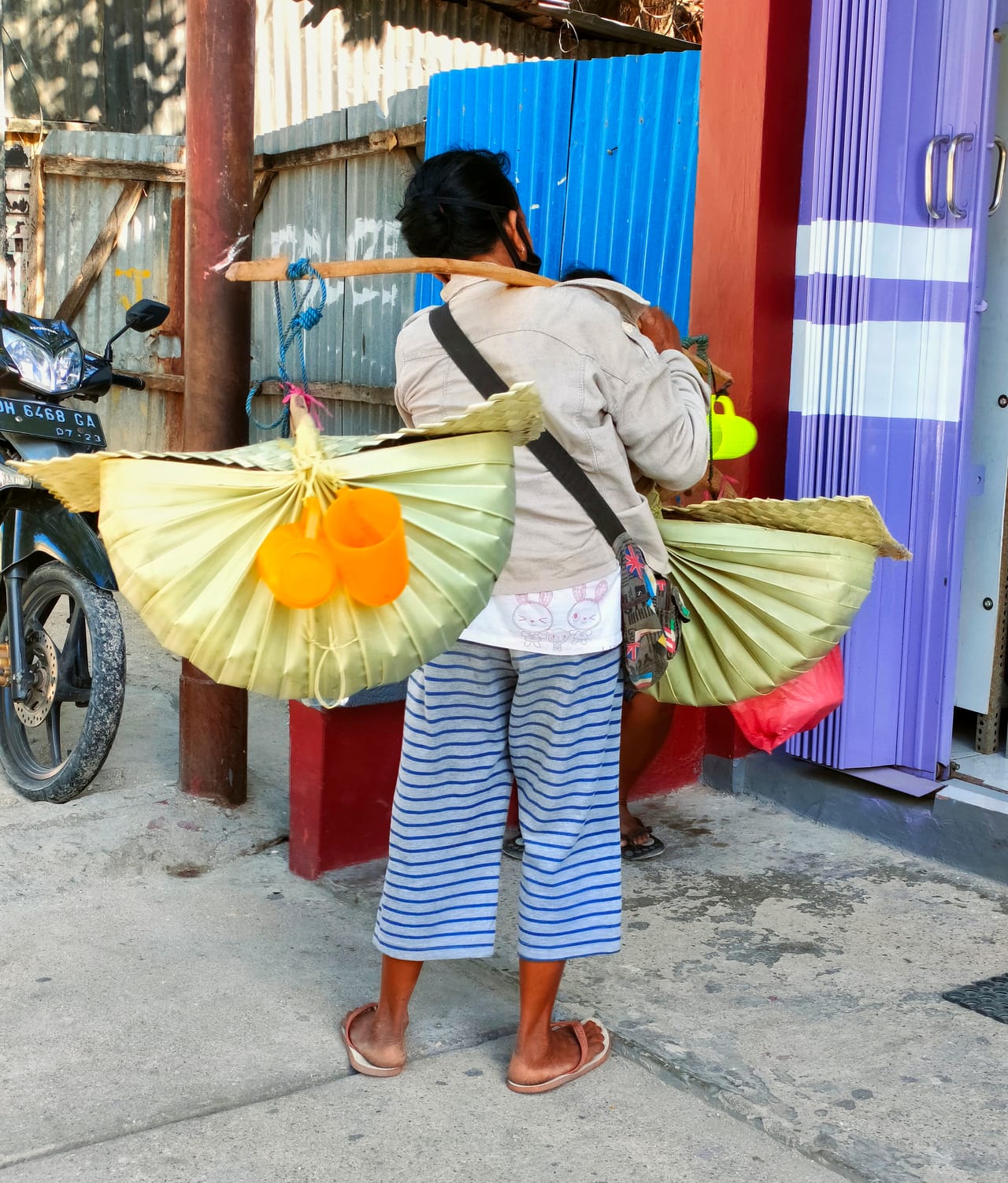
Walk the Tuesday floor and you’ll see the island’s real diet laid out. Fish and live crab near the front, still moving. Piles of leafy greens, long beans, chilli, shallots, tubers, the odd mound of tomatoes when the season is kind. Trays of eggs. Sacks of rice and dried corn. Then the non-food rows creep in, secondhand clothes, hardware, motorbike parts, and the small pyramids of betel that older sellers chew through the morning. Threaded through all of it are the products of the lontar palm, the sugar and syrup that sweeten half of what the island eats. It maps closely onto the everyday food most households actually cook, heavy on fish, tubers and rice, with meat saved for ceremonies rather than midweek dinners.
The birds tell you something too, if you’re standing there long enough to notice. Rote sits under a busy little sky. Naturalists have logged thousands of wildlife records around the island, and the commonest by far are small resident birds, honeyeaters, flowerpeckers, white-eyes, swiftlets and the tree sparrows that work every market floor in the region for dropped grain. 3 That last one you’ll meet personally, hopping between the rice sacks while a seller shoos it off with a cloth.
What matters more for your cooking is the list of what never shows up. The stalls are honest about the island’s limits. The land here is young sedimentary rock, limestone and marl laid down over the last couple of million years, better suited to hardy tubers, corn and salt flats than to a broad temperate vegetable garden. 4 So you learn the absences fast. Certain vegetables come and go with no warning. Anything imported, good coffee beyond the local grind, particular spices, specialist baking or cooking gear, decent cheese, most of what a Western kitchen treats as staples, simply isn’t part of the trade. If your recipe needs it and the island doesn’t grow it, the market can’t help you, and no amount of walking the aisles will change that.
What to bring, and how to ask the price
Bring cash, and bring it small. Nobody at the market is breaking a large note for a bunch of greens, and there’s no card terminal at a fish table. Keep a fold of small denominations for exactly this, the way you’d keep coins for parking somewhere else. This is the same discipline the island asks of you generally, and it lines up with the wider cost of living reality here, where cash is king and running dry between bank runs is a genuine hazard.
Bring your own bags too. Plastic gets handed out thin and torn, and after a few weeks you’ll want something that survives wet fish and a scooter ride home. A sturdy basket or a couple of heavy totes earns its keep by the second market morning.
On price, the market rewards patience over sharp elbows. Prices at Pasar Ba’a run well below the little warung shops near the beaches, which is exactly why you’re bothering to drive in. You can ask what something costs and gently ask again, but this is a small island where you’ll see the same seller every week for months, so the goal is to be a regular they’re glad to see. A friendly “berapa?” and a smile does more for your standing than any hard haggle. Buy from the same women each week, learn their names, and the good fish starts finding its way to you before it hits the table.
Tie the morning to a slow afternoon
Since you’re already up and out, the market pairs naturally with the kind of unhurried day the island does best. Once the shopping’s stowed and cool at home, an afternoon at Telaga Nirwana behind Oeseli is the classic follow-on, the hidden lagoon that only works when the tide is in. The difference between the postcard and a bare mudflat is a couple of hours either side of high water, so you time the visit to the tide. Bring water shoes for the urchins in the shallows, and go on a weekday when you’ll likely have the place to yourself.
This is what the island really offers long-stayers, a set of small, unhurried outings you fold into ordinary months instead of a checklist you sprint through in a week. The market keeps the week honest, the tide keeps the afternoon honest, and the whole thing runs at the pace of the place rather than yours.
When the island can’t supply it
At some point your kitchen will want something Rote doesn’t sell, and no market morning will fix that. Good coffee, a specific spice, a proper knife, a cut of meat you can’t get fresh, the ingredients behind se’i done properly at home. That’s when the supply chain moves up a level, off the island entirely.
The practical answer is sourcing from Kupang, and beyond it Bali and Java, then getting it across on the ferry. Someone buying on your behalf in the city, consolidating a cargo run and holding it for you in Kupang or Ba’a, closes the gap between what the stalls grow and what your kitchen actually needs, which is exactly what island procurement is built for. Understand that split early and you’ll never be caught out. The market feeds you the fresh, seasonal, local half of your week. Everything else has to be brought in, and once you’ve set up a reliable way to do that, cooking here stops feeling like a compromise and starts feeling like living.
Sources
Footnotes
-
Rote Island — dati (Wikidata). wikidata.org ↩
-
Current Issues in Hospitality and Tourism: Research and Innovations. books.google.co.id ↩
-
Geologia dell’area di Rote Island (Macrostrat). macrostrat.org ↩